Askeland
The CallerAskeland is an aging housing estate adjoining the newer Bjerketun across a dense grove of trees. The contrast between the two developments gives the landscape a social as well as practical shape: its paths connect the estates, while its neglected appearance and Johnny Beskow’s life there make it a setting for the novel’s account of isolation, intimidation, and movement between home and target. During the investigation of the blood prank on Margrete Sundelin, Konrad Sejer treats Askeland as a possible point of origin; in Johnny’s story, it is the place from which he imagines and carries out his influence over others.
Setting and layout
Askeland’s seventy-four homes were built in the 1960s. They are described as square, faded, and brooding, a marked contrast to Bjerketun, the estate built in the early 1990s on the other side of the grove. Bjerketun has sixty well-maintained homes, most with gardens, double garages, and large verandas. The two estates are not far apart, but the grove between them gives the boundary a physical presence: it conceals a path and offers cover, while still allowing a person to pass from one housing area to the other.
The surrounding distances help locate Askeland within the wider community. Bjerketun lies four kilometres from Bjerkås, where about five thousand people live. Sejer and Jacob Skarre study these connections on a map, tracing the main road from Bjerkås to Bjerketun and then toward Askeland. The map turns a suburban arrangement into a set of possible routes, linking the estate not only to its neighbour but to the town and the woods between them.
The estates also carry different social associations. A third of the Askeland homes had been assigned by the local authority to welfare recipients, a circumstance associated in the narration with a growing sense of decay. Bjerketun, by contrast, is presented through its cared-for homes and the Sundelins’ plans to preserve their garden for Margrete. The contrast does not make the estate itself responsible for what happens there; it does establish the unequal social landscape through which the novel’s investigation and characters move.
The grove and the investigation
After the blood prank on Margrete, Sejer studies the map with Skarre and proposes that the person responsible may have come from Askeland. He traces a possible route through the trees to Bjerketun, where someone could have approached the pram carrying blood in a bottle or a bag, watched from behind a tree, and then retreated through the grove. At this point, this is an investigative hypothesis rather than a confirmed account: Sejer does not know what kind of blood was used or where it came from, and he waits for laboratory results to clarify whether it could have been bought at an abattoir.
The route is more than a line on a map. Sejer’s reconstruction depends on the grove’s cover and on the short connection between the estates; the landscape supplies an opportunity that the investigation can test. When he later drives directly to Askeland, he cannot readily find the trail leading toward Bjerketun. He asks boys playing football for directions, and they lead him behind an old barracks-like clubhouse to a narrow forest path. They explain that it reaches a logging road within minutes, and that a walker heading to Bjerketun must keep left; the journey takes about half an hour. Their local knowledge gives the route a lived, everyday dimension that the map alone cannot provide.
Johnny Beskow’s home ground
Askeland is also Johnny Beskow’s home. He lives there with his mother, and his domestic life is marked by neglect: when he slips into the hallway one late morning, he expects to find her drunk and discovers her asleep beneath a blanket on the sofa. He moves quietly to his room, where Bleeding Heart, his guinea pig, offers a form of companionship. The episode places Johnny’s isolation inside an ordinary household and helps explain the importance he gives to attention and control without treating his surroundings as an excuse for his actions.
With Bleeding Heart at his neck, Johnny savours the thought that people believe what he tells them and respond when he calls or writes. He imagines that he could disrupt a whole community, even a city, through these acts. The feeling reverses the status he associates with being called the wimp from Askeland at school: in his own mind, his capacity to deceive gives him power despite his physical weakness. The estate is thus both the setting of his marginality and the imagined base from which he can reach beyond it.
His later movements across Askeland retain that mixture of resentment and fantasy. In late summer, as the vegetation dries and the estate seems to him drained of freshness, he passes the houses as part of his routine. He has twice been offered heroin there and refused, valuing his own clarity and sharpness against the sleepwalking image he applies to the addicts he sees. The passage establishes that drugs are available in the area, but also distinguishes Johnny’s self-image from the people he dismisses.
Routes, targets, and significance
Askeland’s position connects Johnny’s residence to the routes he uses in planning an attack on Else Meiner. Near Hauger School, he approaches the school grounds while a band is rehearsing. To avoid being heard by Else, he pushes his moped toward the bicycle shed rather than riding the final stretch. From the playground he looks beyond a red-and-white barrier to the narrow paved Love Trail, a route he knows from before he owned the moped. He believes Else, who lives at Bjørnstad, will use it on her way home to Rolandsgata after band practice. He counts on that journey as the opportunity for the revenge he has been plotting.
Else’s route shows how the novel’s locations acquire meaning through repeated use. The school, the barrier, the trail, and the surrounding bushes are not interchangeable scenery: Johnny reads them as a sequence of approach, concealment, and anticipated passage. His knowledge of the local paths makes his plans concrete, while the gap between his imagined command over events and other people’s vulnerability lends those familiar spaces menace.
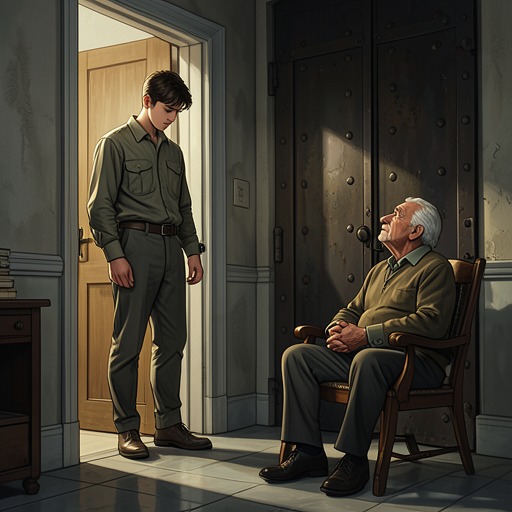
Askeland also connects Johnny’s domestic and social lives. After spending an afternoon with his grandfather, Henry Beskow, Johnny carries the dishes to the kitchen, retrieves a plastic canister from a shed, and fills it at Bjørnstad Centre. Walking back across the estate with the heavy container, he imagines his mother welcoming him warmly and offering him food. The fantasy contrasts with the neglect he encounters at home, while the physical errand grounds his movements in the local geography. Later, after passing the Meiner home without seeing Else, he returns to Henry’s house and declares his own invincibility in thought. Askeland is therefore not simply the bleak backdrop to Johnny’s actions: it is the familiar terrain across which his loneliness, fantasies of power, and plans of revenge take shape.